Watch the full webinar on demand
Catch the full session with Dr. Lisa Evans and Laurence VogtTétaz.
BLACK FRIDAY SALE: Earn up to 50% off on selected courses!
Blog
Share This Post
The role of the learning designer is changing fast. Organizations are trying to upskill their people at scale, quickly and in ways that feel personal, and AI is reshaping how learning gets built and delivered. In higher education, student expectations are shifting just as quickly.
Learning designers are at the centre of all this. But if we spend our days helping others upskill, we also need to look hard at our own development.
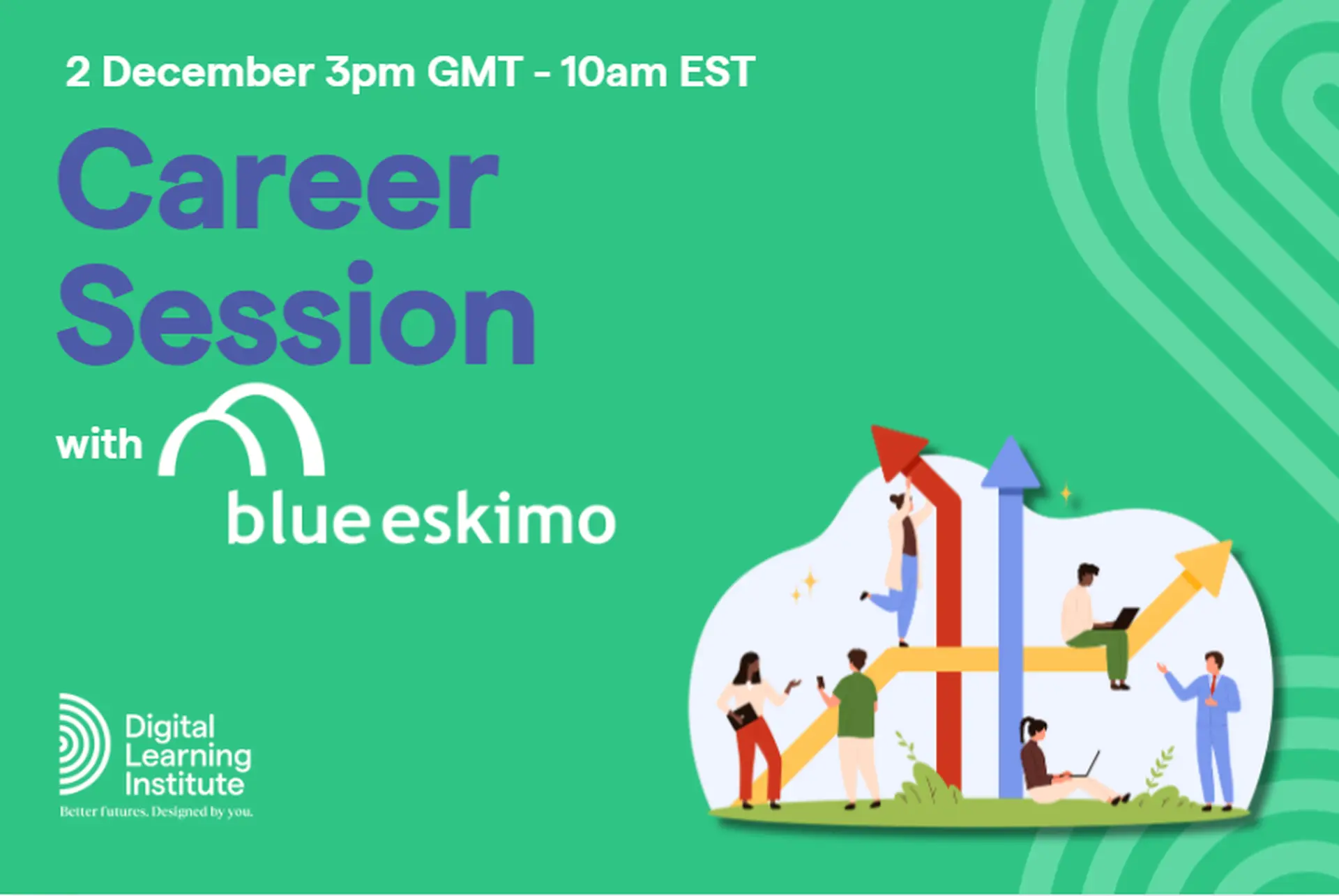
That was the starting point for a recent DLI session on career progression. John Kilroy was joined by Dr. Lisa Evans, Academic Director of the MS in Learning Design and Technology at the University of San Diego (USD), and Laurence “Lo” Vogt-Tétaz, who works in learning and development at a pharmaceutical company in Switzerland. Lo is a graduate of both DLI’s Certificate in Immersive Learning and USD’s master’s, and she completed them at the same time.
Here’s what they had to say about the skills employers are looking for, and what Lo’s own journey shows about building them.
Catch the full session with Dr. Lisa Evans and Laurence VogtTétaz.
According to Lisa, one thing has stayed consistent over time: employers want people who bring both. Job descriptions ask for familiarity with ID models, adult learning principles, authoring tools and LMSs. But they also look for strong communication, and Lisa was specific about what that means. It is the ability to communicate concisely, comprehensively and confidently.
That skill shows up at every stage of a project. You need to explain what you’re doing and why, to clients, to your team and to stakeholders. Even when a project runs over time or over budget, you should be able to explain what happened in the workflow, because you understand the whole process.
Lo added influencing, negotiating, stakeholder management and adaptability to the list. In her role she works with subject matter experts from production, quality assurance and quality control, each with a different background. Adapting her approach to each one is part of the job.
Lisa also highlighted two qualities that help learning designers earn a seat at the table:
Curiosity. Not stopping at “I’ve never done this before”, but knowing how or where to find the answer, and taking personal responsibility for upskilling before anyone asks you to.
Empathy. Stakeholders arrive with different experiences and priorities. Understanding them builds rapport and keeps you from becoming an obstacle to the solution.
As for whether the role is becoming broader or more specialized, Lisa’s answer was a balance. Specialized foundational knowledge is what you bring to problem-solving, while AI can take on more task-based work. Lo’s experience reflects the broader side: alongside learning design, her role now includes culture transformation, project management and communications support.
AI can produce learning content in seconds. What it can’t reliably do is judge whether that content is any good. That judgement comes from understanding how people learn.
Lisa gave a simple example. Ask AI to generate three learning outcomes from some content and you’ll get something that sounds right: “learners will understand…”, “learners will know…”. An experienced designer will spot the problem immediately. With Bloom’s Taxonomy in mind, they’ll see that the outcomes describe cognitive processes but lack the action verbs that make them measurable. The words match the content, but the outcomes can’t be assessed.
The fix isn’t to avoid AI. It’s to bring your expertise into the prompt, for example by asking for objectives aligned with Bloom’s across lower and higher order thinking, and to treat AI as a thought partner rather than accepting its first answer.
Lo does exactly this. She has set up dedicated AI projects for writing learning objectives, building assessments and creating quizzes, each preloaded with her standards for Bloom’s, cognitive load and accessibility. She’s also exploring AI coaching tools that let people managers practise difficult conversations, such as performance reviews, whenever they have 30 minutes to spare.
The same knowledge shapes everyday design decisions. As Lisa put it, once you understand how the brain processes audio and visual information, a slide is no longer about picking a nice template. You know when adding audio would cause cognitive overload, and you can explain why you’re recommending a design choice.
John noted that more learning design job specs now include a quality assurance element: evaluating outputs against pedagogical standards. When it comes to AI skills, the panel’s advice was to start with prompting and with your workflow, not the tools. Look at where the inefficiencies are, work out where AI could help, test it, and be clear about where you add value as the human in the loop.
Lo sees the future of the role clearly: learning designers becoming trusted learning partners. L&D can’t be an isolated department that simply responds to requests. It needs to understand where the business is heading over the next five years and make sure people have the capabilities to get there.
For Lo, that means asking three questions:
How does this learning initiative connect to business objectives?
Can I identify performance gaps before anyone asks me for a solution, then analyse them and make a proposal?
What business outcome are we enabling, and how can I measure and show the value I’m creating?
John pointed out that L&D has often jumped into solution mode too quickly, deciding on a course before understanding the problem. Sometimes structured learning isn’t the right answer at all. There will always be a place for it, particularly in compliance, leadership development and skills-based programs. But AI is making personalized, in-the-moment learning much easier to deliver.
Lisa’s advice for moving towards “courseless” L&D was to start with the right questions. Why are we pushing this training? What outcome are we looking for, and could we reach it another way? Options include microlearning, on-demand performance support, and pre-assessments that let people start at different points depending on what they already know. Lo described the same shift in her own work, towards development programs built around the 70-20-10 model and making sure learning is actually applied on the job.
Lo’s route into L&D wasn’t planned. She studied business management with a focus on finance, took an HR internship, and gradually moved towards learning and development because it was the area she found most interesting. She was promoted to L&D specialist and built her knowledge on the job.
After about six years, she wanted to understand the science behind the work she was doing every day. While researching options, she found DLI’s Certificate in Immersive Learning and USD’s MS in Learning Design and Technology. She couldn’t choose, so she did both.
She saw the two as complementary rather than competing. The DLI certificate let her specialize in an area that was new to her, from virtual and augmented reality to 360-degree video and immersive simulations, all highly relevant to the pharmaceutical industry. The master’s gave her greater depth and breadth.
She completed both while working full-time, planning a wedding and, by the end, expecting a baby. She’s honest that it wasn’t easy. What made it possible was the programs were flexible enough to fit around her job, and a real commitment to staying focused.
For her master’s projects, she always chose real problems from work, so she was improving her job while she studied. The impact has been significant. Until 2024, training at her company was SOPs and classroom sessions only. Since then she has created a learning design framework, developed the company’s first e-learning modules, and introduced videos and more interactive workshops.
The biggest change, she said, was confidence. Before, her solutions were based on how she’d been taught on the job, with gaps she didn’t know existed. Now she can back her decisions with evidence, drawing on cognitive load theory, Mayer’s principles, Bloom’s Taxonomy and the Kirkpatrick model. She applies them without overwhelming stakeholders with jargon. She has changed how she thinks, how she designs and how she influences.
Choosing between a certificate and a master’s. Lisa suggested starting with the kind of work you want to do. Look at the jobs you’re drawn to and take stock of the gaps in your skills. If you want to focus on hands-on development and tools, a specialist certificate may be the right fit. If the roles you want involve design, analysis, data and stakeholder work, a degree may serve you better. Or, like Lo, you may find value in both. When comparing programs, check the course descriptions, the faculty’s experience and accessibility, and whether you can hear from alumni.
Moving from higher education or teaching into corporate L&D. Lisa was clear that the transition is absolutely possible. Lean heavily on your prior experience, because what you’re really selling is how you think and solve problems. John added that teachers’ skills in working with stakeholders and designing curriculum transfer directly to instructional design. Don’t underestimate what you already have. Focus on how you present it.
Making the case for funding. Lo funded her studies herself, with help from family, after trying to negotiate employer support. John’s advice is to put yourself in your manager’s shoes and be specific about the tangible outputs your studies will produce. At DLI, every student completes a work-based project, which makes that case easier. With employers focused on AI, show how the program will help you add value as workflows are redesigned. And don’t forget the less obvious benefits: time to step back and rethink how you work, and a network of people in other sectors facing the same problems.
DLI has partnered with the University of San Diego to give our Professional Certificate in Digital Learning and Instructional Design graduates a structured progression route into USD’s MS in Learning Design and Technology. Completing the DLI certificate brings up to six academic credits. That means you can skip the master’s two foundation courses and complete it in 8 courses instead of 10, saving a semester in both time and tuition.
Find out more about the DLI and USD partnership here.
See how to apply for the master’s here.
If you have questions about the master’s, the USD team will be happy to help. If you’d like to talk about which DLI programme is right for you, get in touch with our team.
Browse DLI's free resource library including expert-led masterclasses, webinars, ebooks, and toolkits to help you stay at the forefront of digital learning.