Live Events
Beyond Detection: Rebuilding Assessment for Durable Human Capability
Share This Post
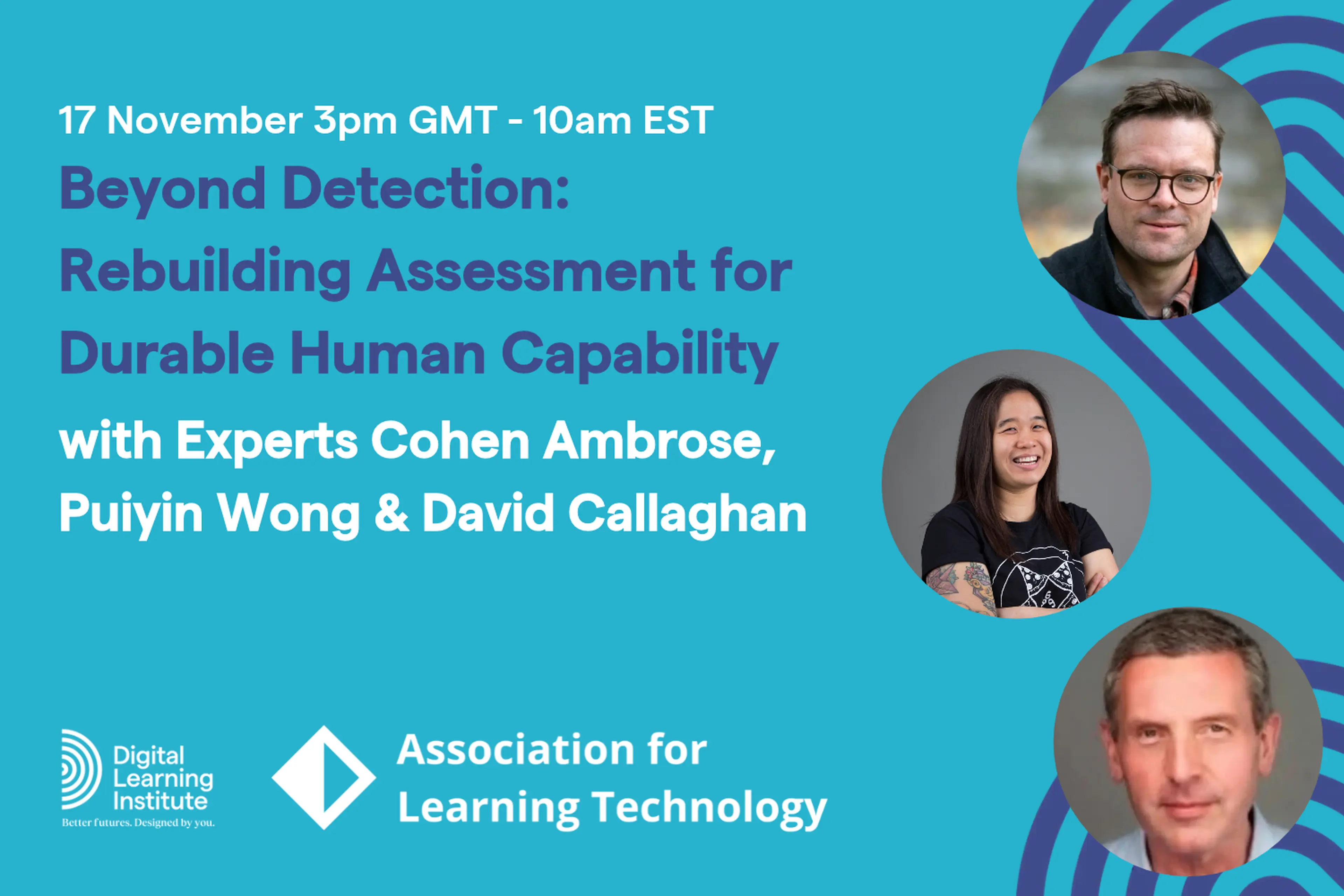
When: November 17, 3PM GMT / 10AM EST
Where: Live online, 60 minutes
As AI transforms how learners write, analyze, solve problems, and create, how can we ensure assessment still provides meaningful evidence of learning?
Join the Digital Learning Institute (DLI), in partnership with the Association for Learning Technology (ALT), for a FREE panel discussion exploring the future of assessment in an AI-rich world.
With generative and agentic AI becoming increasingly embedded in education, traditional approaches to assessment are being challenged. If AI can produce polished assignments, reports, and projects, how do we know what learners truly understand and can do?
Should institutions continue investing in AI detection and monitoring, or is it time to rethink how we assess learning altogether?
Bringing together experts from digital learning and higher education, this panel will explore how assessment can move beyond detecting AI use to focus on developing and demonstrating durable human capabilities, including critical thinking, judgment, problem-solving, and the ability to apply knowledge in new contexts.
What We'll Explore
Beyond AI Detection: Should institutions focus on identifying AI-generated work, or redesign assessment to better demonstrate authentic learning?
Assessing Human Capability: How can we assess critical thinking, understanding, judgment, and the ability to verify and apply knowledge in an AI-rich environment?
Rethinking Assessment Design: Exploring program-level approaches that build a more meaningful picture of learner development over time.
Practical Steps for Educators: What can educators, learning designers, and support teams do now to make assessment more meaningful, inclusive, and resilient?
About the Experts
Puiyin Wong
Puiyin is a multi-award winning educator, including Advance HE CATE Team Lead 2026 and recipient of the OEGlobal Award for Excellence 2025. She is Senior Academic Lead for Digital Education at Buckinghamshire New University, leading the strategic development of digital education and learning design, and a Trustee of the Association for Learning Technology (ALT).
Puiyin is also a PhD researcher at Lancaster University, exploring the interplay between pedagogy and technology in learning and professional development. With over 20 years’ experience in higher education, she is passionate about connecting people and creating conditions for collaboration across the sector and internationally.
As a Global Majority academic, Puiyin is committed to creating inclusive spaces for colleagues from underrepresented groups. She is the founder and lead of the renowned #TELresearchers and #HEresearchers community, connecting educational researchers and practitioners at different career stages around the world.
David Callaghan
David Callaghan is a Senior Educational Technologist with over ten years’ experience in Higher Education. He specialises in Technology-Enhanced Learning (TEL), instructional design and curriculum development, supporting academic staff to make effective use of digital tools to enhance teaching, learning and assessment.
With an academic background in Computer Science and E-Learning, David is passionate about sharing best practice, supporting innovation and helping educators get the most from technology. He is also an active contributor to the TEL community, a reviewer for ALT and BJET, and a published author.
Cohen Ambrose
Cohen Ambrose is Learning Experience Manager at the Digital Learning Institute and an educational developer, learning experience designer, and researcher with over 15 years’ experience across higher education and professional learning.
His work focuses on digital pedagogy, learning theory, and the evolving role of AI in education. He has led the design and delivery of blended and online programmes, supported educators in developing effective learning experiences, and contributed to curriculum and programme reform across both academic and workplace contexts.
Cohen’s research and practice centre on how learning design can better support performance, transfer, and learning in the flow of work.
Share This Post